

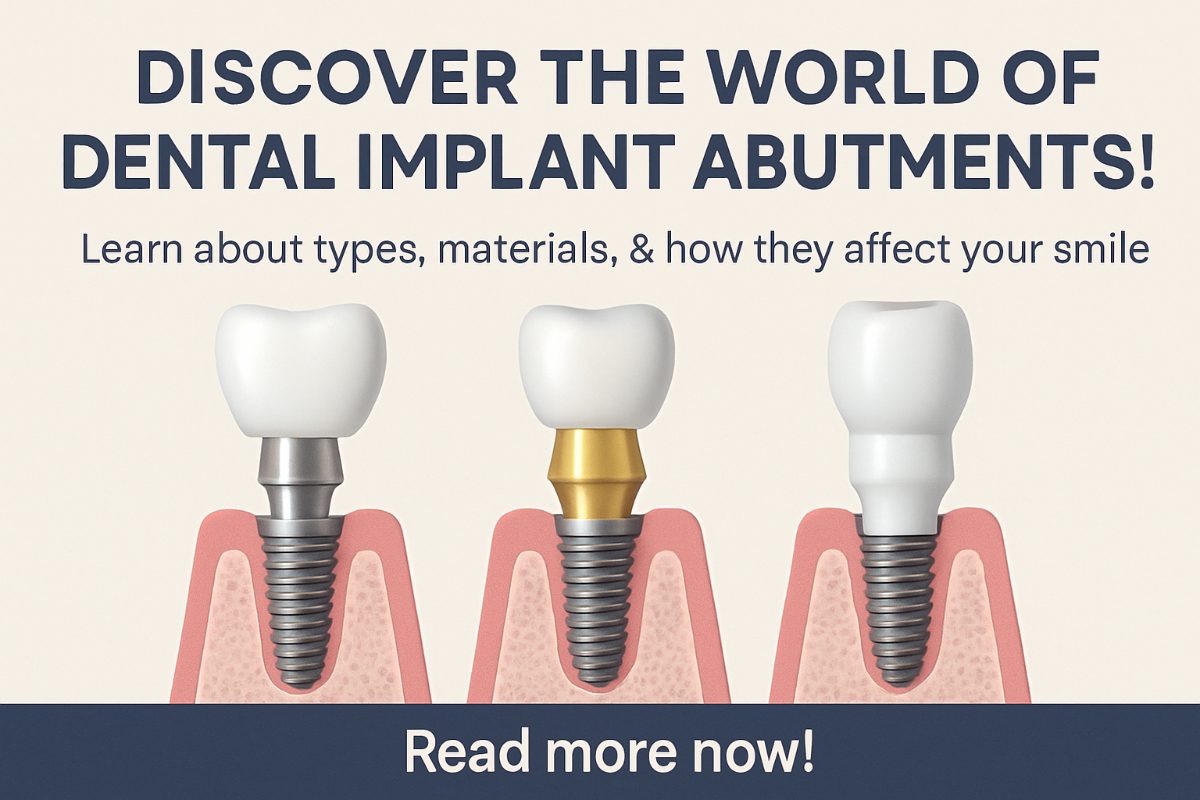
A dental implant abutment is the small connector piece that joins an implant (the metal post in your jaw) to the visible crown or denture. Abutments affect how your new tooth looks, how your gums heal around it, and how well the implant withstands chewing forces. This post explains the main types of dental implant abutments, common materials and connection styles, how choices affect function and esthetics, what to expect at your appointment, and which questions to ask your implant surgeon.
What Are Dental Implant Abutments?
An abutment sits on top of the implant and supports the crown, bridge, or denture. Think of the implant as the root and the abutment as the piece that lets you attach the tooth. There are temporary (healing) abutments used during recovery and final abutments that stay under the permanent crown. Temporary abutments shape the gum as it heals; final abutments are shaped and chosen for long-term function and appearance.
Main Types Of Abutments
Stock (prefabricated) vs. Custom abutments
Stock abutments are pre-made and come in standard sizes. They cost less and are quicker to place. The fit may be good for simple cases, but stock abutments sometimes need more adjustments and may not match the gum shape perfectly. Custom abutments are designed for your specific tooth and gums using digital scans. They usually fit better, look more natural at the gumline, and help the soft tissue heal in an ideal shape. Custom abutments cost more but often give better esthetic and functional results.
Angled and multi-unit abutments
Angled abutments correct the angle when an implant cannot be placed perfectly upright. They let the crown sit straight even if the implant tilts. Multi-unit abutments are used for full-arch restorations (like implant-supported dentures) to connect multiple implants to a single prosthesis. These options make treatment possible in cases with limited bone or challenging anatomy.
Temporary (healing) abutments
Healing abutments protect the implant while the gum tissue matures. They help form the emergence profile—the natural-looking curve where the tooth meets the gum. Once healing is complete, the temporary abutment is replaced with the final abutment and crown.
Materials Matter: Titanium, Zirconia, And More
Titanium: Strong, highly biocompatible, and widely used. Titanium abutments are durable and work well in most back-tooth situations where esthetics are less critical. Zirconia: White and tooth-colored, ideal for front teeth where the abutment could show through the gum. Zirconia looks better under thin gums but is more brittle than titanium. Hybrid (titanium base with zirconia sleeve): Offers the strength of titanium plus the esthetics of zirconia. These hybrid abutments are common when both durability and appearance matter. Your surgeon will choose the material based on location (front vs. back), gum thickness, bite forces, and esthetic goals.
Connection Types And Why They’re Important
Internal hex, external hex, and Morse taper
These terms describe how the abutment locks to the implant. External hex was an older style with a small protruding hex; it can be easier to loosen. Internal hex fits inside the implant and offers better stability. Morse taper is a friction-fit connection that creates a tight seal with minimal microgap. The type of connection affects stability, the chance of screw loosening, and how well bacteria are kept out of the implant-abutment junction.
Screw-retained vs. cement-retained restorations
Screw-retained crowns are attached with a screw through the crown into the abutment. They are easy to remove if repairs are needed. Cement-retained crowns are bonded over the abutment for a clean appearance but can trap excess cement, which may irritate the gum and increase the risk of infection if not cleaned properly. Your surgeon will weigh retrievability, esthetics, and gum health when choosing.
How Abutment Choice Affects Function And Esthetics
Emergence profile and soft-tissue health
A well-shaped abutment supports the gum so the crown looks natural as it meets the tissue. Custom abutments let the clinician sculpt the emergence profile to mimic a real tooth. This helps prevent gaps, food traps, and gum recession.
Load distribution and long-term success
Material and connection affect how chewing forces are distributed. Strong materials and stable connections reduce the risk of fractures and screw loosening. Proper selection lowers the chance of complications and extends the life of the implant restoration.
Are All Dental Implant Abutments The Same?
No. Dental implant abutments differ by design (stock vs. custom), purpose (temporary vs. final), material (titanium, zirconia, hybrid), and connection type (internal hex, external hex, Morse taper). Myths like “all abutments are interchangeable” or “zirconia is always best” are false. The right abutment depends on your mouth, location of the tooth, gum thickness, bite, and long-term goals.
What To Expect At Your Abutment Appointment
– Evaluation: Your surgeon checks healing, gum shape, and bite. – Imaging or digital scan: X-rays or a digital impression help plan the abutment and crown. – Trial abutment: A temporary may be placed to shape the gum and test fit. – Seating the final abutment: The final piece is placed and secured to the implant. – Crown placement: The crown is attached, either screwed or cemented. Pain control options may include local anesthesia, conscious sedation (you remain awake but relaxed), or IV sedation (you sleep). Your team will discuss what’s safest and most comfortable for you.
Questions To Ask Your Implant Surgeon
– Which abutment material do you recommend for my case and why? – Do I need a custom abutment, or will a stock abutment work? – Will my restoration be screw-retained or cement-retained? Why? – How will this abutment affect my gum health and appearance? – What are the maintenance needs and warranty for the abutment and crown?
Why Choose Our Clinic For Implant Planning And Abutments
Dr. Eric M. George, DMD, DABOI, DICOI, MAGD, FAAID, FMIII, FAADS, FICD is a board-certified implant surgeon with advanced credentials and mastership in general dentistry. Our practice uses CT 3D imaging for accurate diagnosis, digital scanners for putty-free impressions, and advanced treatment planning for predictable results. We offer soft-tissue lasers for precise gum shaping and sedation options for comfort. These technologies improve fit, accuracy, healing, and long-term outcomes for dental implant abutments and restorations.
Quick Wrap-Up And Call To Action
Dental implant abutments are not all the same — they vary by type, material, and connection, and those choices matter for how your tooth looks and functions. If you have questions about which dental implant abutments are right for you or want a personalized evaluation, schedule an appointment to discuss options and next steps.