

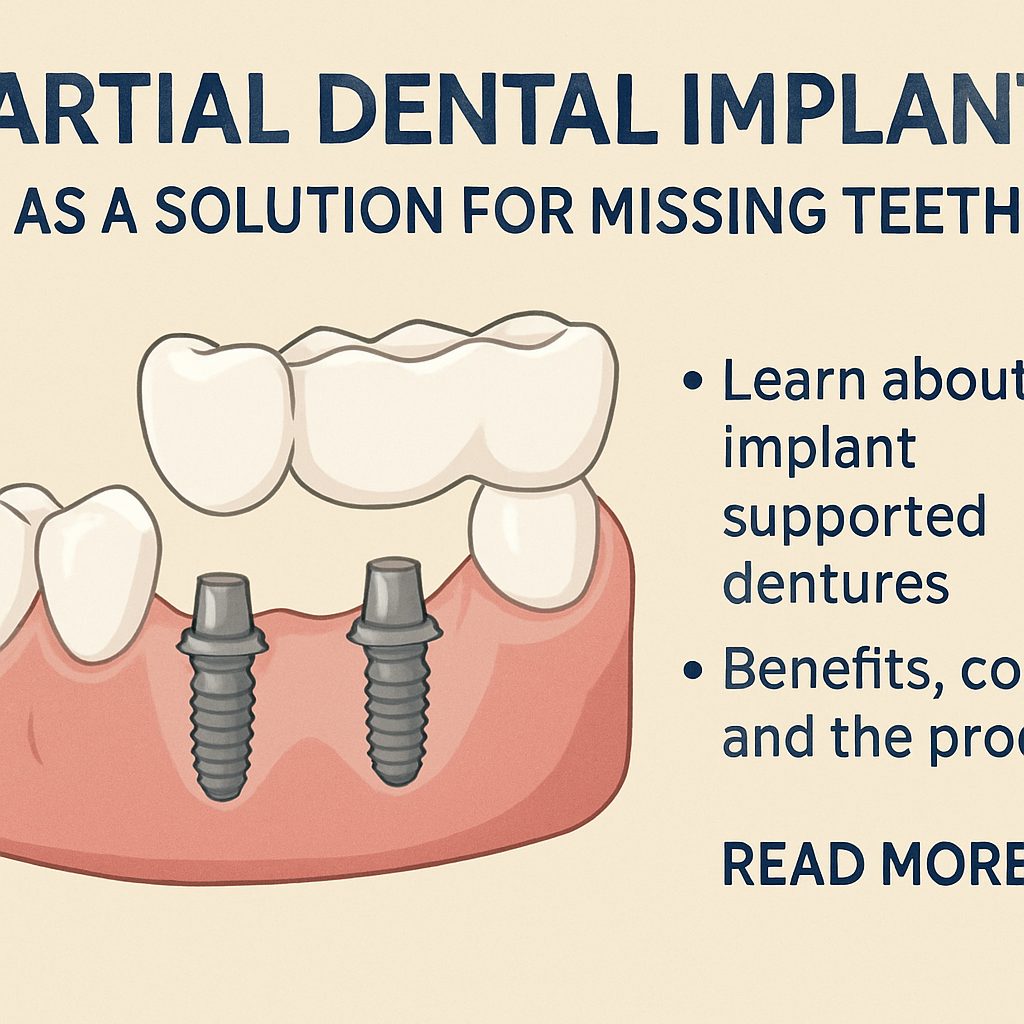
This article explains what partial dental implants are, how they compare to implant supported dentures, who benefits, the procedure and technology used, costs and risks, and how to get started. Read on for clear steps you can take next if you’re considering replacing one or several missing teeth.
What Are Partial Dental Implants?
Partial dental implants are implant-based solutions that replace one or several missing teeth without treating an entire arch. Instead of placing an implant for every missing tooth, a dentist may place implants that support crowns or small bridges to fill gaps. This differs from single-tooth implants (one implant per tooth) and from full-arch implant solutions that replace all teeth on the upper or lower jaw.
Partial implants aim to restore chewing, speech, and appearance while preserving nearby natural teeth and jawbone. They are a middle-ground option for patients who want more stability than a removable partial but do not need a full-arch rebuild.
Partial Dental Implants vs Implant Supported Dentures
Implant supported dentures use multiple implants to anchor a denture that replaces most or all teeth in an arch. They are ideal when many teeth are missing or failing. By contrast, partial dental implants target limited gaps. A removable partial denture clips onto remaining teeth and can be less stable than an implant-based option.
Clinicians often choose a partial implant solution when:
- Only a few teeth are missing in a localized area
- Enough bone exists where implants are planned
- The patient wants a fixed or semi-fixed restoration rather than a removable appliance
Types of partial implant solutions
- Implant‑retained crowns — a single implant plus a crown to replace one tooth.
- Implant‑retained bridges — two or more implants supporting a bridge that replaces several teeth.
- Local implant clasps — small implant anchors used with a partial denture to improve fit and retention.
Who Is A Good Candidate For Partial Dental Implants?
Good candidates for partial dental implants typically have:
- One or several missing teeth that affect chewing or appearance
- Healthy gums and good oral hygiene
- Adequate bone in the area for implant support (or willingness to have grafting)
- A desire for fixed teeth or a more stable partial than a removable appliance
Some factors may require extra treatment before implants: significant bone loss, active gum disease, heavy smoking, uncontrolled diabetes, or certain medications that affect bone healing. When implants aren’t appropriate, alternatives include conventional removable partial dentures or a fixed bridge supported by natural teeth.
What To Expect: Procedure, Tech, And Timeline
Modern implant care uses technology to plan and place implants precisely and comfortably.
- Pre-op planning: CT scanners provide 3D images for accurate diagnosis and digital case planning. This helps place implants in the safest, strongest position.
- Digital impressions: Intraoral scanners create putty‑free impressions and speed lab communication, sometimes enabling same-day provisional crowns or faster workflows.
- Surgical tools: Soft‑tissue lasers reduce bleeding and improve healing in some cases.
- Sedation options: Conscious or IV sedation is available to keep you comfortable during surgery.
Typical timeline:
- Consultation and 3D imaging — treatment plan and cost estimate
- Surgery and implant placement — may include bone grafting if needed
- Healing period (osseointegration) — usually several weeks to a few months
- Final restoration — crowns or bridges attached once implants integrate
Some practices offer streamlined or same-day provisional restorations depending on the case and available technology.
Benefits, Costs, And Insurance Considerations
Key benefits of partial dental implants include improved stability, better chewing function, preservation of jawbone, comfort, and easier hygiene compared with removable partials. They can also protect neighboring teeth by avoiding the need to prepare healthy teeth for a traditional bridge.
Costs vary based on:
- Number of implants needed
- Need for bone grafting or sinus lifts
- Material and lab fees for crowns or bridges
- Use of advanced technology or sedation
Many dental insurance plans limit implant coverage or exclude it. Patients often face coverage gaps. Financing options, dental loans, and in-office payment plans can help spread costs. Your office should provide an upfront estimate and help you understand insurance benefits.
Risks, Recovery, And Long-Term Care
Common risks include infection, implant failure, nerve or sinus issues in rare cases, and temporary swelling or discomfort. Careful planning with CT imaging and digital workflows lowers these risks.
Recovery tips:
- Follow post-op instructions closely (medications, diet, oral rinse)
- Expect mild swelling and tenderness for a few days
- Avoid smoking—smoking increases failure risk
- Call your dental office for severe pain, fever, or unusual swelling
Long-term care: brush and floss around implants daily, keep regular dental exams and cleanings, and use a night guard if you grind your teeth. With good care, implants can last many years or decades.
About Dr. Eric M. George and How To Get Started
Dr. Eric M. George, DMD, DABOI, DICOI, MAGD, FAAID, FMIII, FAADS, FICD is a board‑certified implant surgeon and general dentist with advanced diplomates and mastership honors. He uses CT scanners, digital treatment planning, soft‑tissue lasers, digital scanners, and sedation to deliver evidence‑based, patient-centered implant care. Dr. George is an international lecturer and multiple Rhode Island Top Dentist honoree.
To schedule a consultation: call the office or request an implant evaluation online. Bring any recent dental records or X‑rays and a list of current medications to your first visit. The consultation includes a review of your medical history, 3D imaging when needed, and a clear treatment plan with costs and options. If you’re considering partial dental implants or implant supported dentures, request an implant evaluation to learn which choice fits your needs.